
Uttanasana
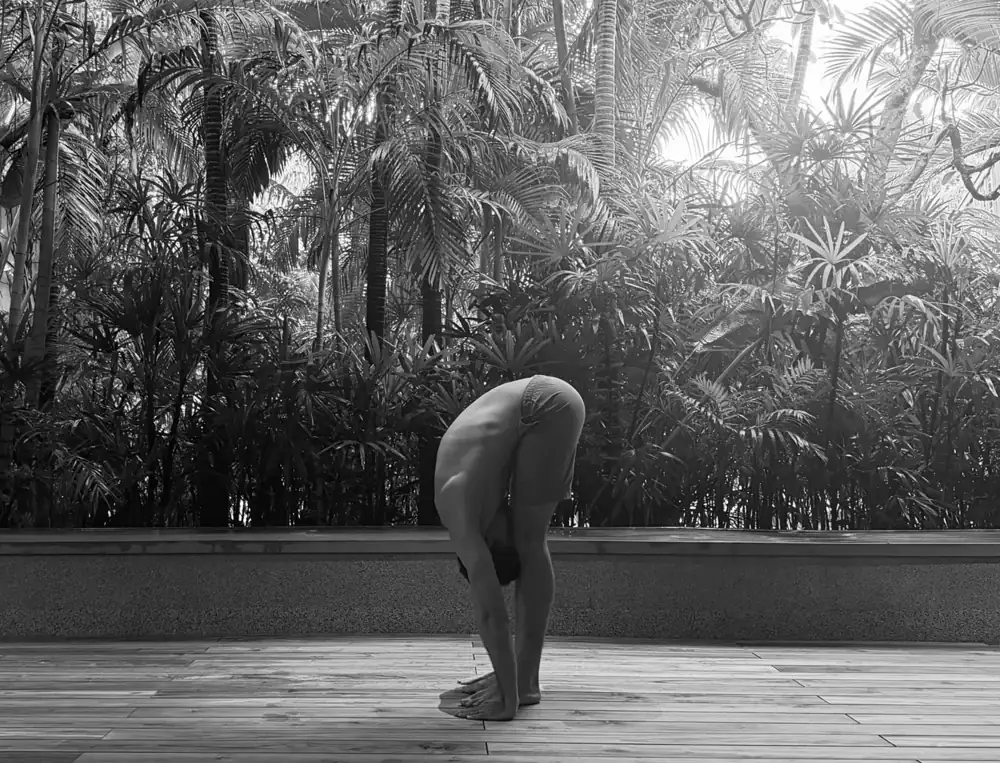
Standing Forward Bend
uttana = intense stretch
Written and reviewed by The Kriya Yogi · Updated 25 September 2026
A standing forward fold that lengthens the back body and quiets the mind by bringing the head below the heart.
- Family
- Forward bends
- Level
- beginner
- Lineage
- modern
- Works on
- hamstrings · calves · spine
The yogic view
Uttanasana does not appear by this name in the Hatha Yoga Pradipika or Gheranda Samhita; standing forward folds of this kind are part of the twentieth-century vocabulary built up in modern postural yoga schools, especially the Mysore and Iyengar lineages. It is best understood as a modern asana rather than a classical one, even though forward bending itself has ancient roots in seated postures like Paschimottanasana.
Benefits
- Lengthens the hamstrings and calves while decompressing the lumbar spine
- Encourages the head to release below the heart, said to calm an agitated mind
- Stretches the entire posterior chain from heels to skull
- Prepares the spine and legs for deeper forward folds and standing sequences
- Offers a brief inversion-like rest between standing postures
How to practise
- Stand in Tadasana with feet hip-width apart.
- Exhale and hinge forward from the hip joints, keeping the spine long as you descend.
- Let the hands come to the floor, blocks, or the shins, wherever the back stays extended.
- Bend the knees generously if the hamstrings pull the lower back into rounding.
- Shift weight slightly forward into the balls of the feet and let the head hang heavy.
- Draw the inner thighs back and the sitting bones up to lengthen the fold.
- Stay for five to ten breaths, then release the crown of the head toward the floor.
- To rise, bring hands to hips, engage the low belly, and lift with a flat back on an inhale.
For seated or floor-based work, use a clean, stable surface with enough support for comfort.
Common mistakes
- Rounding the lower back to reach the floor: bend the knees and use blocks instead of forcing straight legs.
- Locking the knees, which strains the joint: keep a micro-bend throughout.
- Letting all the weight sink into the heels: rock forward slightly onto the balls of the feet.
- Rushing the exit and straining the back: rise with a flat spine, hands on hips, leading with the chest.
Variations and progressions
- Easier: Ardha Uttanasana, a half-lift with hands on a wall or blocks to keep the spine long.
- Easier: bend the knees deeply and rest the belly on the thighs, arms hanging.
- Harder: bind the hands behind the calves and draw the torso closer to the legs.
- Harder: lift onto the toes to intensify the calf stretch and balance challenge.
Breath and energy
Uttanasana is usually practised as an exhale-led pose, the breath emptying as the torso folds toward the legs. Bringing the head below the heart is traditionally associated with a cooling, introspective effect, and many teachers link the fold to Ajna and Manipura, quieting outward-directed energy and turning attention inward. A soft Mula Bandha can be maintained to protect the lower back and keep the fold supported rather than collapsed.
What research shows
Forward folds like Uttanasana are commonly studied for their effect on hamstring flexibility, and repeated practice reliably increases hamstring range of motion over weeks. Claims that the pose relieves stress are supported mainly by general findings that slow forward bends with long exhalation lower heart rate and self-reported tension; there is no evidence for detox or organ-specific effects sometimes attributed to it.
Questions about Uttanasana
+ Is Uttanasana a classical or modern pose?
+ Why do my hamstrings hurt so much in this pose?
+ Should my legs be straight?
+ Can beginners do Uttanasana?
+ What is the breathing pattern?
+ How long should you hold Uttanasana?
+ What are the modifications for Uttanasana?
+ Who should avoid or modify Uttanasana?
+ What should you practise before and after Uttanasana?
+ What does Uttanasana mean in Sanskrit?
Prepare with
Release with
Cautions
- back injury
- high blood pressure (come up slowly)
More forward bends
- Ardha Uttanasana · Half Standing Forward Bend
- Parsvottanasana · Pyramid Pose
- Trianga Mukhaikapada Paschimottanasana · Three Limbs Facing One Foot Forward Bend
- Upavistha Konasana · Wide-Angle Seated Forward Bend
- Prasarita Padottanasana · Wide-Legged Forward Bend
- Marichyasana B · Pose Dedicated to Marichi, B
Keep reading
Educational content, not medical advice. Check with a doctor before starting new practices if you have a health condition or are pregnant.