
Viparita Naukasana
Reverse Boat Pose
viparita = reversed, nauka = boat
Written and reviewed by The Kriya Yogi · Updated 25 September 2026
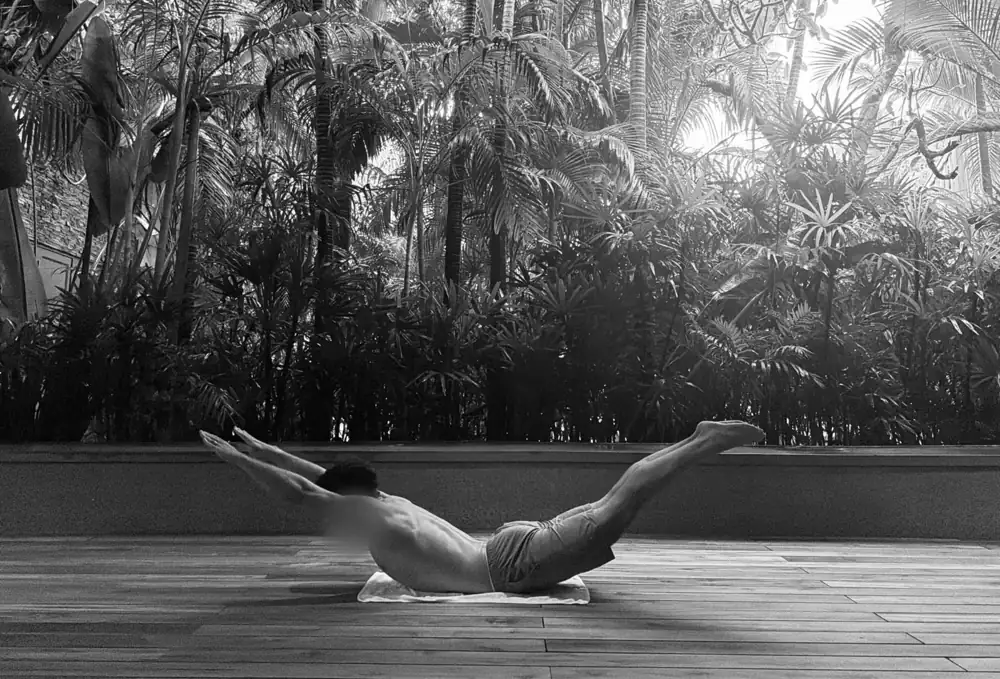
The reversed boat — lying face down with arms, chest and legs lifted together, so the body curves like a hull rocking on its keel. A demanding whole-body backbend that strengthens the entire back line at once.
- Family
- Backbends
- Level
- intermediate
- Lineage
- modern
- Works on
- back · glutes · legs · shoulders · abdomen
The yogic view
Viparita Naukasana does not appear in the classical manuals — the Hatha Yoga Pradipika and Gheranda Samhita know the prone backbends Bhujangasana, Shalabhasana and Dhanurasana, but not this combined shape. It belongs to the twentieth-century vocabulary of yoga, where teachers joined the boat of Navasana to the prone line of the locust. We present it honestly as a modern posture: effective, widely taught, and best understood as an intensification of Shalabhasana rather than an ancient practice in its own right.
Benefits
- Strengthens the whole posterior chain at once: spinal extensors, glutes, hamstrings and the back of the shoulders.
- Builds endurance in the muscles that hold the spine upright against desk-bound posture.
- Opens the chest and the front of the shoulders while the back body works.
- Demands steady breathing under effort — a useful training for concentration.
- Prepares the body for deeper prone backbends such as Dhanurasana.
How to practise
- Lie face down with the legs together and the arms stretched forward overhead, palms facing each other.
- Rest the forehead lightly on the floor and take two quiet breaths to settle.
- On an inhale, lift the arms, chest and legs away from the floor in one smooth curve, balancing on the lower abdomen.
- Reach forward through the fingertips and back through the toes; keep the neck long, gaze on the floor ahead.
- Breathe steadily for three to five breaths, then lower everything on an exhale and rest with the cheek on the floor.
- Repeat two or three times, resting between efforts.
For seated or floor-based work, use a clean, stable surface with enough support for comfort.
Common mistakes
- Holding the breath — the pose is hard, and the breath is the first thing lost. If you cannot breathe, lower a little.
- Cranking the head up, which compresses the neck; the lift comes from the back, not the chin.
- Bending the knees to fake height, which shifts the work out of the back and into a loose shape.
- Kicking up with momentum instead of a slow, controlled lift.
- Squeezing the buttocks so hard the lower back pinches; keep the glutes engaged but the sacrum long.
Variations and progressions
- Half boat: lift only the arms and chest, or only the legs, until the full shape is available.
- Hands alongside the body, fingertips reaching back, for a milder version closer to Shalabhasana.
- Rocking gently forward and back on the abdomen once the balance is found — an advanced variation that massages the front body.
- Build up through Bhujangasana and single-leg Shalabhasana before attempting the full pose.
Breath and energy
A heating, stimulating posture. The whole back body fires at once, the breath is pressed against the floor, and the effort gathers energy upward along the spine. Practise it early in a session while fresh, follow it with a quiet child's pose, and let the breath return to normal before moving on.
What research shows
Reverse boat is a compound back-extension exercise, and back-extension training has reasonable evidence behind it: strengthening the spinal extensors and glutes is a standard part of physiotherapy for chronic, non-specific low-back pain, and endurance in these muscles is associated with better spinal support. Nothing specific to this yoga shape has been studied in trials, so claims beyond general strengthening should be treated cautiously. The pose loads the lumbar spine in extension, which is exactly why it is unsuitable during acute back pain or disc problems.
Questions about Viparita Naukasana
+ Is Viparita Naukasana the same as Navasana?
+ What muscles does Viparita Naukasana strengthen?
+ Is this pose safe for a sensitive lower back?
+ How long should I hold Viparita Naukasana?
+ Is Viparita Naukasana a classical pose?
+ Is Viparita Naukasana suitable for beginners?
+ What are the modifications for Viparita Naukasana?
+ Who should avoid or modify Viparita Naukasana?
+ What should you practise before and after Viparita Naukasana?
+ What does Viparita Naukasana mean in Sanskrit?
Release with
Cautions
- back injury
- pregnancy (avoid)
- high blood pressure (keep holds short)
- recent abdominal surgery
Keep reading
Educational content, not medical advice. Check with a doctor before starting new practices if you have a health condition or are pregnant.