Om Explained: The Mandukya Upanishad, the Yoga Sutras, and How It's Actually Chanted
Written and reviewed by The Kriya Yogi · Updated 22 September 2026
Om (also written Aum) turns up on yoga studio walls, jewellery and album covers, usually with a caption that treats it as self-evidently meaningful. The classical explanation is more specific and, honestly, more interesting than the decorative version — and it comes with a clear textual source rather than a vague gesture at 'ancient wisdom'.
Before you read on
- Om is written Aum in transliteration because it is traditionally analysed as three sounds — A, U, M — not one.
- The Mandukya Upanishad, a short but philosophically dense text, maps these three sounds onto three states of consciousness (waking, dreaming, deep sleep) and adds a fourth, silent element (turiya) representing pure awareness beyond the three.
- The Yoga Sutras (1.27–1.28) identify Om as the word that expresses Ishvara, to be repeated with contemplation of its meaning.
- Traditional chanting extends the M sound into a long nasal hum (similar to Bhramari) rather than clipping it short.
- There is no credible evidence for claims that Om carries a specific measurable 'universal frequency' — that is a modern claim, not a classical or scientific one.
The syllable that's actually three sounds
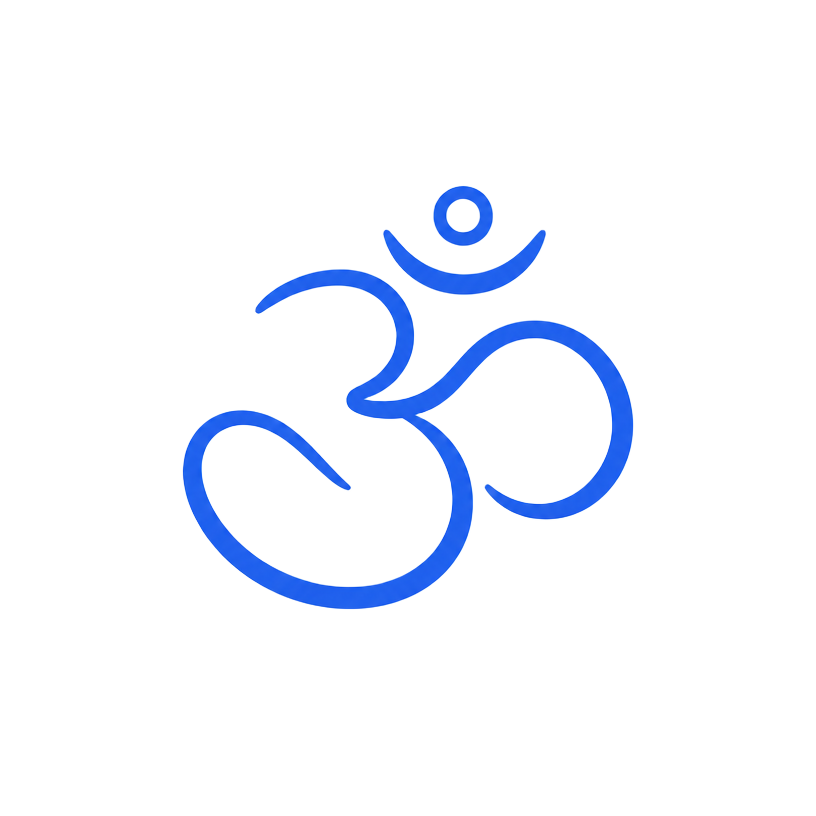
Written in Devanagari as a single symbol, Om is nonetheless analysed in Sanskrit phonetics and philosophy as three component sounds: A, U and M. This is why you'll often see it transliterated as Aum rather than Om — the spelling is trying to preserve the three-part structure that the compressed single symbol and single English syllable both obscure. When chanted with attention to this structure, the sound moves from an open "ah" at the back of the throat, through a rounding "oo" shape of the lips, to a closed "mm" hum with the lips sealed — a sound that, deliberately or not, traces the full range of mouth positions available to human speech, ending in a resonant nasal hum that can be sustained far longer than the vowels.
The Mandukya Upanishad's account
The clearest and most systematic classical treatment of Om's meaning comes from the Mandukya Upanishad, one of the shortest Upanishads (twelve verses) and, despite its brevity, one of the most commented-on in the whole Vedantic tradition. It maps the three audible sounds of Om onto three states of consciousness, and adds a crucial fourth element that has no separate sound of its own:
A — the waking state (jagrat), ordinary consciousness engaged with the external world.
U — the dreaming state (svapna), consciousness turned toward internal, subtle experience.
M — deep, dreamless sleep (sushupti), where individual awareness is present but without the content of waking or dreaming experience.
The silence after the sound, or the whole syllable taken as one — turiya, "the fourth," described not as another state alongside the first three but as the awareness underlying and pervading all of them — pure consciousness itself, prior to and continuous through waking, dreaming and sleep.
This is a genuinely sophisticated piece of philosophical structure, not a decorative association. The Mandukya Upanishad is using the phonetic structure of a single syllable as a compact teaching device for a claim about the nature of consciousness — that ordinary experience (waking, dreaming, sleep) is not the whole of what awareness is, and that something continuous underlies all three. Whether you take that claim as metaphysical fact, as a model worth sitting with, or as historically interesting philosophy is up to you; what's worth getting right is that this account has a specific, identifiable, ancient textual source, rather than being generic "spiritual" content.
Om in the Yoga Sutras
Patanjali's treatment, discussed more fully in the pillar guide to this section, is narrower and less elaborated than the Mandukya Upanishad's. Sutra 1.27 states that the word expressing Ishvara is the pranava — Om. Sutra 1.28 instructs its repetition (japa) together with contemplation of its meaning (bhavana), as one route (among others the text offers) to steadiness of mind. Patanjali doesn't repeat or engage with the Mandukya Upanishad's three-states framework directly in this passage — the two texts are related by shared cultural and philosophical context rather than one directly quoting the other — but both treat Om as carrying a meaning worth contemplating, not merely a sound to be produced.
How Om is traditionally chanted
There's some variation between lineages, but a common traditional approach holds a rough proportion across the three sounds — roughly equal or slightly longer time on the A and U, with the M extended into a long resonant hum, often the longest single portion of the whole sound. The hum is usually produced with the lips sealed and the sound directed so it can be felt as vibration in the lips, teeth, and sometimes the crown of the head — mechanically similar to the humming bee breath (Bhramari pranayama) described elsewhere on this site, though Om chanting is usually done as a vocalised recitation with meaning attached rather than purely as a breathing technique.
A single chanted Om typically lasts somewhere from ten to twenty seconds depending on breath capacity and pace, chanted on a full exhalation after a full inhalation, often repeated for a set count (frequently on a mala, following the guidance in the mala guide in this section) or for a fixed period of time such as three, nine, or 108 repetitions.
Common misconceptions worth correcting
"Om is a universal healing frequency measurable at a specific pitch (often claimed to be 432 Hz)." This is a widely circulated modern claim with no basis in the Mandukya Upanishad, the Yoga Sutras, or any other classical source, and it isn't supported by acoustics either — a chanted Om varies in pitch from person to person and has no fixed universal frequency. It's worth naming this claim as a piece of modern wellness marketing rather than ancient teaching.
"Om automatically calms the nervous system through vibration." What's better supported is the more modest and mechanistic explanation: chanting Om, like other sustained vocalisation, involves a long, controlled exhalation, which is the same mechanism behind slow-breathing practices generally associated with a calmer subjective state. That's a real, if unglamorous, effect — distinct from claims about vibration acting directly on organs or the brain in ways not demonstrated by evidence.
"Om means 'peace.'" It doesn't translate as a word in that sense; it's treated in the sources above as a sound-symbol for ultimate reality or consciousness itself (Ishvara in the Yoga Sutras' framing, Brahman/atman in Vedantic framing), which is a considerably larger claim than "peace," even if peace is one plausible experiential effect of sitting with it.
Trying it
If you'd like to chant Om as part of a practice, the japa practice guide in this section covers building this into a regular daily rhythm, and the mala guide covers using a count if you want a structured number of repetitions rather than an open-ended session.
How to practise it
Sit with an easy, upright spine
As with any seated practice, a stable and relaxed seat matters more than a particular posture. Chair or floor, whichever holds you upright without strain.
Take a full, unforced inhalation through the nose
No need to gasp for maximum air — a comfortable full breath is enough to sustain the sound that follows.
Begin the sound as an open 'ah' and let it round into 'oh'
Let the sound move naturally from an open throat toward rounded lips, rather than forcing a sharp transition.
Close the lips and let the sound become a long humming 'mmm'
This is usually the longest part of the sound. Let it resonate rather than trailing off weakly — you can feel it as vibration in the lips and face.
Pause in silence before the next repetition
The brief silence between repetitions is traditionally considered part of the practice, corresponding to the 'fourth,' turiya, described in the Mandukya Upanishad — not empty time to rush through.
Repeat for a set count or a set period
Three, nine, or a full round of 108 on a mala are all common; there's no single required number.
Worth knowing
- Chant at a volume and pitch that's comfortable for your own voice; there's no requirement to chant loudly or at a specific pitch to 'do it correctly.'
- If you have a respiratory condition or find sustained exhalation uncomfortable, shorten the sound or reduce repetitions rather than pushing through breathlessness.
- Be skeptical of claims that a specific frequency or pitch of Om produces a specific measurable physical effect — this isn't supported by classical sources or by acoustic science.
Sources and evidence
The Mandukya Upanishad's three-states-plus-turiya framework for Om is a well-established, extensively commented-upon part of classical Vedantic literature, and the Yoga Sutras' treatment at 1.27–1.28 is equally well attested in the primary text. The physiological effects of chanting are best understood through the broader, moderately evidenced literature on slow, controlled exhalation and subjective calm (see the breathing guides on this site), rather than through claims specific to Om's pitch or 'frequency,' which are not supported by controlled research.
Questions people ask
+ Why is Om sometimes spelled Aum?
+ What does Om actually mean?
+ Is it true that Om is tuned to a specific healing frequency?
+ Do I need to understand the Mandukya Upanishad to chant Om meaningfully?
+ How long should I chant Om for?
References
- Mandukya Upanishad (full text is only twelve verses; widely available in translation, e.g. in Eknath Easwaran's or Patrick Olivelle's Upanishads translations).
- Patanjali, Yoga Sutras 1.27–1.28.
- The Bhramari (humming bee breath) guide on this site — /resources/breathing — for the mechanics of sustained humming exhalation.
Educational content, not medical advice. Check with a doctor before starting new practices if you have a health condition or are pregnant.