
Ubhaya Padangusthasana
Both Big Toes Pose
ubhaya = both; pada = foot; angustha = big toe; asana = seat or posture. The posture in which both big toes are held.
Written and reviewed by The Kriya Yogi · Updated 20 September 2026
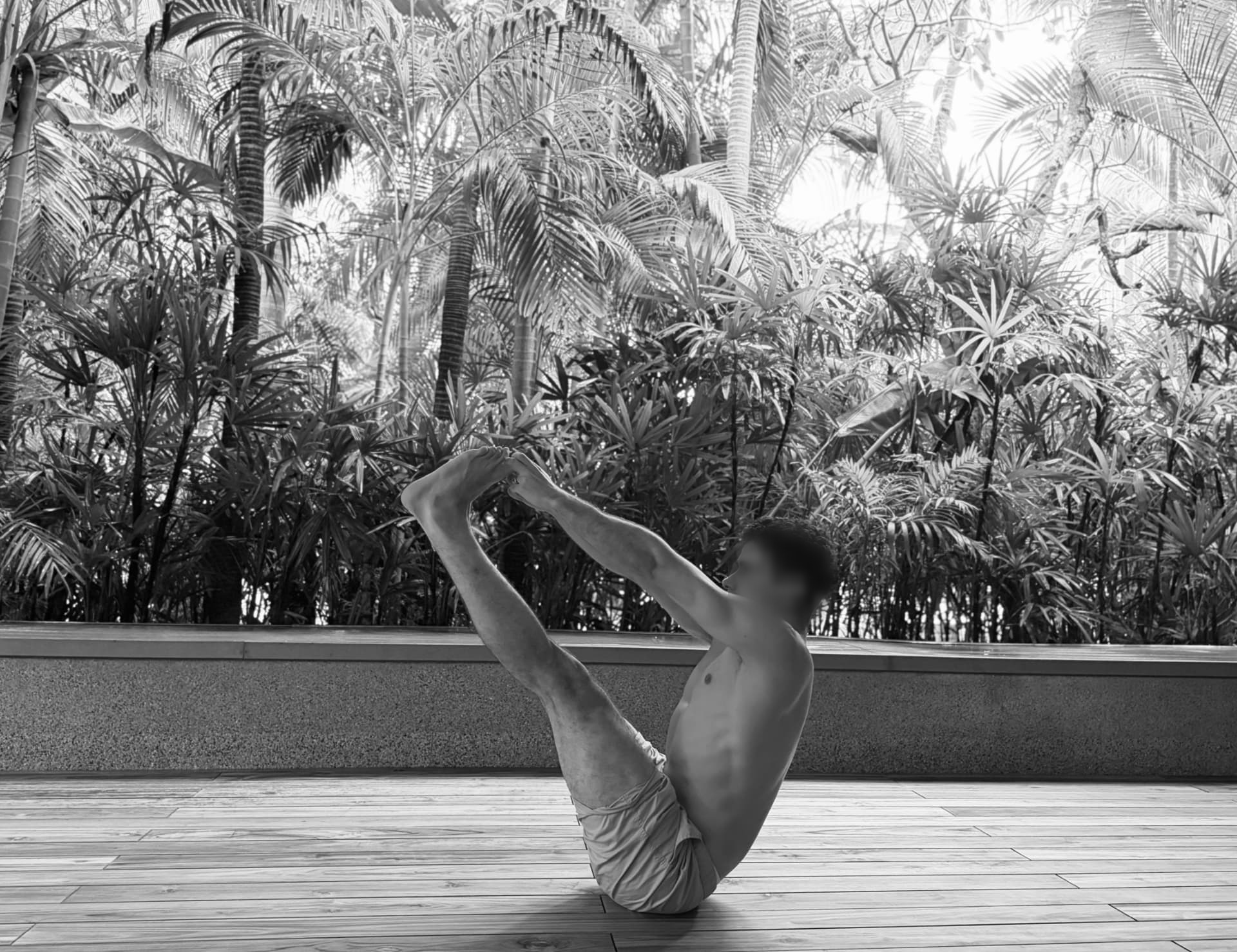
A seated balance on the sitting bones: both legs lift straight, both big toes are held, and the chest stays open while the spine lengthens. It teaches the hamstrings and the deep abdominals to work together without the floor to lean on.
- Family
- Balance
- Level
- intermediate
- Lineage
- modern
- Works on
- hamstrings · hip flexors · deep abdominals · balance · spinal extensors
Note on the sources: Ubhaya Padangusthasana is not named in the Hatha Yoga Pradipika, the Gheranda Samhita or the Yoga Sutras. It appears in twentieth-century Mysore teaching, where it sits in the Ashtanga Vinyasa primary series as one of the two lifted balances that follow the finishing forward bends. We present it as a modern posture built out of classical parts — the seated fold and the held big toe — and not as an ancient one.
The yogic view
There is no verse to quote for this posture, so we will not invent one. What tradition does give it is lineage: the hand-to-big-toe grip (padangustha) runs through the classical seated folds, and Paschimottanasana — the intense stretch of the west, named in chapter one of the Hatha Yoga Pradipika — is the shape this balance is lifted out of. Teachers in the Mysore line describe the pose as a test of whether a forward bend has become real strength rather than passive hanging: if the hamstrings only lengthen when gravity pulls them, the legs will not stay straight once they are in the air. In that reading the posture is diagnostic. It shows the practitioner what they actually own.
Traditional framing also treats the lifted balances as preparation for sitting. Holding the torso upright on the sitting bones, with the pelvis neither dumped back nor jammed forward, is the same skill a long meditation seat asks for — practised here under load, for ten breaths at a time.
Benefits
It builds strength at long muscle length. The hamstrings hold a straight leg while fully lengthened, which is where most people are weakest and where hamstring strain risk is highest.
It finds the real balance point of the pelvis. Without the floor to lean against, you cannot fake an upright spine. The posture tells you immediately whether you sit on your sitting bones or behind them.
It teaches abdominal work that does not shut down the breath. The deep front line must hold the torso up for ten breaths, which rules out gripping and bracing.
It transfers to your seat. The same pelvic position practised under load here is the one that makes long sitting comfortable rather than slumped.
It is honest feedback. Progress in this posture is not cosmetic: the legs either straighten with the chest open or they do not.
How to practise
-
Sit in Dandasana on a firm surface, legs straight, hands beside the hips. If the pelvis rolls backwards here, sit on the front edge of a folded blanket before you go further.
-
Bend the knees and take hold of the big toes — index and middle finger hooked around the toe, thumb pressing down on top. If the toes are out of reach, loop a strap around each foot and hold the strap short.
-
Roll back very slightly onto the sitting bones, not onto the sacrum. This is the whole difficulty of the posture: the balance point is forward of where most people expect it.
-
Lengthen the legs towards straight while keeping the grip. Straighten to the point where you can still lift the chest. A slight bend in the knees with an open chest is the pose; locked legs with a collapsed back is not.
-
Draw the lower belly in and up, lift the sternum, and pull gently on the toes while the feet press away. The two forces hold each other.
-
Look forward or slightly up, without throwing the head back. Neck long.
-
Stay five to ten smooth breaths. Breathe into the sides of the ribs — the belly has work to do.
-
To come out, bend the knees, release the toes, and lower the feet with control. Sit for two or three breaths before moving on.
For seated or floor-based work, use a clean, stable surface. Our natural cork yoga mat offers a grounded 5 mm surface for regular practice.
Common mistakes
Rolling back onto the sacrum. The most common error. The back rounds, the chest drops, the legs float up by default. Come forward onto the sitting bones even if the legs must bend.
Straightening the legs at the cost of the spine. Straight legs are not the goal. An open chest with slightly bent knees is a better posture than locked knees and a collapsed back.
Yanking on the toes. Pulling hard with the arms drags the shoulders forward and closes the chest. The pull is light; the lift comes from the belly and the back.
Holding the breath. If the breath stops, the hold is too long. Come down at five breaths and build.
Throwing the head back to help the balance. It does not help, and it compresses the neck. Keep the throat soft and the gaze steady.
Practising it cold. This is not an opening posture. Warm the hamstrings and the hips first.
Variations and progressions
Strap at the feet. For most practitioners this is the version to stay with for months. Loop a strap around both feet, hold it short, and work exactly the same lift.
One leg at a time. Hold one big toe with the leg lifted, the other knee bent with the foot on the floor. Half the load, all of the balance lesson.
Against a wall. Sit with the back a hand-width from a wall so that losing the balance means touching the wall rather than rolling.
Urdhva Mukha Paschimottanasana. The related pose from the same sequence: same grip, but the chest draws towards the shins and the balance shifts. Learn this one second, not first.
Blanket under the sitting bones. A folded blanket tilts the pelvis forward and makes the whole shape available years earlier than bare floor does.
Breath and energy
In the traditional map, the lifted balances belong to the group of postures said to gather energy along the central axis rather than disperse it outward. The description given is of collection: the limbs draw towards the midline, the belly engages, the gaze holds one point, and attention has nowhere to leak. Practitioners often report a bright, alert quality afterwards rather than the softness a long passive fold leaves behind.
We offer that as the traditional reading and as a widely shared practitioner experience, not as a physiological claim. What is observable is simple enough: a posture that demands this much attention leaves very little of it available for anything else, and that is a large part of what concentration practice is.
What research shows
No clinical trial has studied Ubhaya Padangusthasana by name, and any page that tells you otherwise is guessing. What can be said is narrower and better supported.
Hamstring extensibility improves with regular stretching, and the gains come substantially from reduced resistance and improved stretch tolerance rather than from muscle fibres permanently growing longer. Loaded, active positions — where the muscle lengthens while working, as the hamstrings do here holding a straight leg against the pull of the arms — are at least as effective as passive holds for range of motion in trials of stretching and eccentric training, and they carry the additional benefit of strength at long muscle length.
Balance training in seated and unstable positions reliably improves postural control, and deep abdominal and hip-flexor recruitment is measurably higher when the legs are unsupported than when they rest on the floor. That is the honest mechanical account of why this posture is harder than it looks: the same joint angles as a seated fold, none of the support.
What the evidence does not show: this posture does not stimulate organs, detoxify anything, treat disease, or alter hormones. It makes a specific pattern of strength and length available to you, and those effects are worth the practice on their own.
Questions about Ubhaya Padangusthasana
+ Is Ubhaya Padangusthasana a classical posture?
+ What is the difference between this and Urdhva Mukha Paschimottanasana?
+ I cannot reach my toes with straight legs. Can I still practise it?
+ Why do I roll backwards every time?
+ How long should I hold it?
+ Who should avoid it?
+ What should I practise to prepare for it?
+ Is Ubhaya Padangusthasana suitable for beginners?
+ What are the modifications for Ubhaya Padangusthasana?
+ What does Ubhaya Padangusthasana mean in Sanskrit?
Prepare with
Release with
Cautions
- acute lower-back pain or disc injury
- recent hamstring tear
- pregnancy (second and third trimester)
- coccyx injury or bruising
- uncontrolled high blood pressure or glaucoma if the head is thrown back
Keep reading
Educational content, not medical advice. Check with a doctor before starting new practices if you have a health condition or are pregnant.